Announcement

Collapse
No announcement yet.

Long kayak on roof rack of 150?

Collapse
X
 
  • Filter
  • Time
  • Show
Clear All
new posts

  • Long kayak on roof rack of 150?

    I paddle an open water ski (sort of like an ironman surf ski) that is a tad over 6m long and there are some fairly specific areas on the hull that you are able to secure the ski to roof racks.

    I've been looking at options for mounting it to racks on the standard rails but they all look like they will place the ski so that it hangs significantly off the rear of the Prado.

    Does anyone have pics of longer canoes/kayaks/skis mounted to a kayak rack on the standard rails?

  • #2
    Hi there,

    we do this with our Rosco Arctic Raider which from memory is around 5.5m long. We've used both Thule racks to lay it on its side when we also put our sit-on-top up there as well, and a set of ProRack holders to lay it flat when on it's own.

    Overhang front and rear is not that much...you should see it when we put it on my wife's Holden Cruze but it still fits OK.

    Not sure if I've got any photos but will have a look.

    Cheers
    Michael
    [SIZE=2][FONT=arial narrow]2011 Crystal Pearl V6 Kakadu / 3M Tint / Prodigy Brake Controller / GME TX3440 UHF / ABR Battery Tray / Piranha DBE180S+ Isolator / Optima D34 Aux Battery / TJM Airtec Snorkel / ARB Colour Coded Deluxe Winch Bar / ARB Underbody Protection / Outback Ideas Recovery Points / Britax XRay 200 HID Spotties[/FONT][/SIZE]

    Comment


    • #3
      We have a similar problem though our kayaks are just under 5m in length. The Department against Transport regulations here in Q state that you are only permitted an overhang past the rear wheel equal to or less than 60% of the vehicle wheelbase. That means you have about 1.2m max behind the rear most roof rack mount. I cannot possibly comply with that on the Prado and it gets even worse on the Rodeo because the roof bars are on the canopy. The trailer regulation requires no more overhang past the axle or centre of axles than the front overhang. Again this isn't possible because if you comply the front of the kayaks gets very intimate with the spare tyre. Realistically even my bicycle carrier doesn't comply.

      What I try to do is to comply with the intent as much as possible by minimising the rear overhang and making sure the tail of the kayaks is visible with a red/orange flag (compulsory for more than 1.2m overhang anyway) and with the tail light off my bike when I travel at night.

      Given how light kayaks are (and the bikes if you look at that too) the effect of the excess overhang is not an issue.

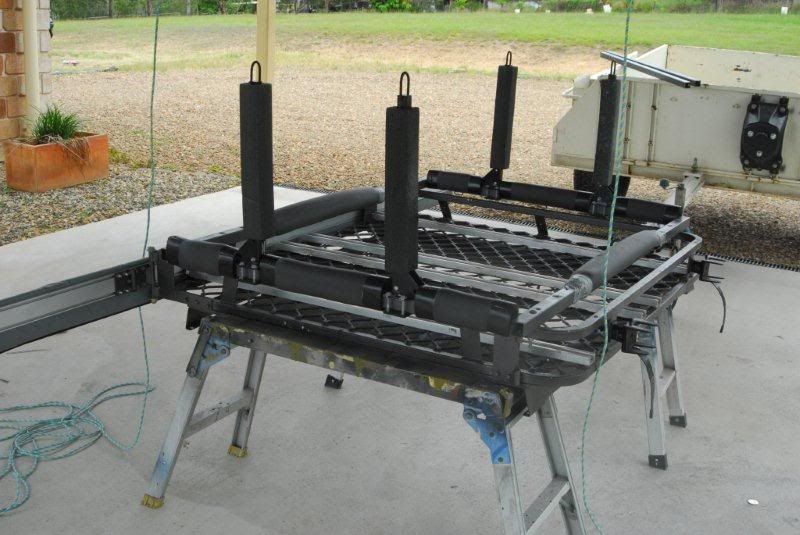
      What I have done is make up a 'universal' kayak frame that I can mount on the Prado roof rack, the Rodeo roof bars, the trailer body and with some extensions over the trailer canopy.

      I have included some pics that show how this sits on my roof rack as the Prado and kayaks are going on a short trip next week. If I remember I will take a couple of shots when the kayaks are up on the car and the bikes are on the back.


      This is an overview of the kayak frame on the roof rack.


      The frame is bolted through the rack and is well supported.


      From the back.

      The frame is just some 35x35x2 steel RHS welded in a rectangle but the key is the length so it suits all the applications. Beneath each kayak I welded a link of chain to hold the tie downs in place, you can see them in the second pic, and the vertical bars are proprietary kayak holders that are about $100 each set.

      I can carry 3 kayaks and four paddles this way. When I use the trailer I can get another two kayaks on that. The paddles ride in Rhino universal carriers bolted onto the rack/frame depending which way I am using the frame.

      My kayaks are fibreglass and are best carried on their sides. They only weigh 18kg each and the frame is another 15kg or thereabouts. The shape of the kayak means I can shift the frame back and forth a fair bit and still have sufficient support without risk of hitting the roof rack or bars etc. I have used self adhesive foam 32x10 on the frame and then covered that with 45 diameter 10 thick pipe insulation. The kayaks have now several thousand kms and all good.

      The frame is easy to make and it would be simple to make it fit the standard cross bars. You could make the shape such that it has legs on the bottom to further push the kayaks forward, bit like the Japanese katakana character Ro if that makes sense or an H with the tops connected. A frame made this way is quite strong and you can bias the frame forwards to minimise the rear overhang. It will depend on the shape of the kayaks and how far they sit below the frame as to where you can situate the frame. I would suggest that you confirm the preferred support spacing for you kayaks and then see how that compares with what you can achieve with cross bars on the Toyota NS rails. There is no need to fit three rails unless your kayaks are heavy in which case you should maybe have them mounted on a roof rack anyway.

      You are never going to be able to make the set up comply but if it looks reasonable and is solid and safe then I do not think you will have a problem.

      To be honest the biggest issue I have is loading the two longer kayaks on the sides because with the roof rack in place the frame is a long way up and even at 1.82m I find it is a struggle to get them up and over the awning and sides. Especially after a paddle when the kayaks are wet.

      Oh and don't forget to wash off the roof as soon as possible if you have had the kayaks in salt water.

      Michael
      mjrandom
      Out of control poster!
      Last edited by mjrandom; 07-01-2012, 08:08 PM. Reason: Tried using English this time
      My 150 build - http://www.pradopoint.com/showthread.php?27423-A-Random-approach-to-a-Bluestorm-150-GXL-D4D-automatic

      Comment


      • #4
        I found a shot of the TK1 on the roof rack from a few years ago, well before I made the frame and as you can see to keep the overhang down the front of the kayak is very nose up. This was a test to check so I don't bother trying even with a kayak that is only 4.1m long. I would think that having the kayak sitting with that attitude would be less safe than an extra 400mm of overhang.


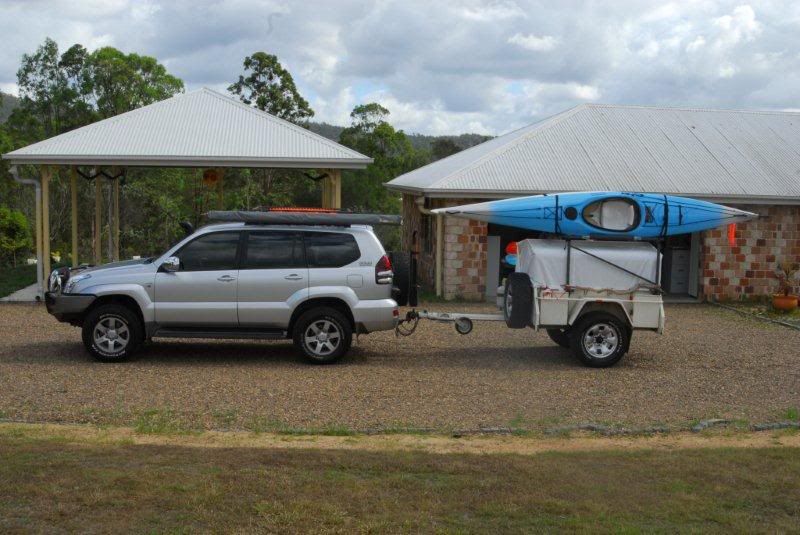
        And for interest and as long as it isn't against rules here (R word following) are a couple of shots of the kayaks on the trailer and the Rodeo.


        Even with the kayaks up over the canopy it isn't possible to sit them 50/50 across the axle. The trailer is an integral part of the camp so we move the kayaks around on the Rodeo if we want to paddle far away places. The frame doubles as a handy storage rack on the ground too. The kayaks overhang the Rodeo canopy by nearly 2m.
        My 150 build - http://www.pradopoint.com/showthread.php?27423-A-Random-approach-to-a-Bluestorm-150-GXL-D4D-automatic

        Comment


        • #5
          Thanks guys.

          I generally paddle and need to transport an Epic V10:


          You are limited to strapping it down around the cockpit area where the complex bends are. If you mount the bulkhead of the ski at the b-pillar which is approximately where the factory rails end, I have similar concerns with complying with rear overhang regulations. The majority of the length in the ski is from the foot pedals backwards (I'm guessing 3.5+m) which often results in significant rear overhang.

          Comment


          • #6
            Well if most of those overhang is behind cockpit can you mount it stern forwards so it comes over the bonnet?
            2011 150series GXL

            Comment


            • #7
              I've toyed with this but the manufacturer has said that for any more than a short, slow drive, that I would have to remove the rudder which becomes a pain in the bum.

              May be the only option when I have to travel longer distances.

              Comment


              • #8
                I use to tow row boats, with expensive carbon fibre rudders also, on some boats they were unable to be removed so we made a 'peter heater' of sorts to slip over the stern and protect the stern and rudder from wind, debris, bugs, etc. would this be an option?
                It took a bit of fabrication to create but when you're towing boats every weekend it makes it much easier.
                2011 150series GXL

                Comment


                • #9
                  Backwards is the go. I assume the manufacturer is worried the rudder will shake around in the breeze so as wooley suggests make up a bag to fit over it and the rear of the vessel and tie it down.
                  My 150 build - http://www.pradopoint.com/showthread.php?27423-A-Random-approach-to-a-Bluestorm-150-GXL-D4D-automatic

                  Comment


                  • #10
                    Thanks guys - Agree that it seems like backwards is the way to go.

                    I will have a play with the mechanism that secures the rudder and see if I can make a small reusable cotter pin type setup work to make rudder removal quicker and easier than the current pin setup.

                    Comment

                    Working...
                    X