Originally posted by AJ120
View Post
-
ahh fair enough. the hooks i've used in the past don't have the retaining plates. thanks. -
can you show me a pic of Boomslang's or anyone elses 120 Prado that is fitted with an ARB Deluxe Winch Bar and also fitted with these recovery points in that location. I would like to see a pic showing it complete, all installed, from underneath without the bash plates so you can see how these recovery points fitOriginally posted by Giles View Post
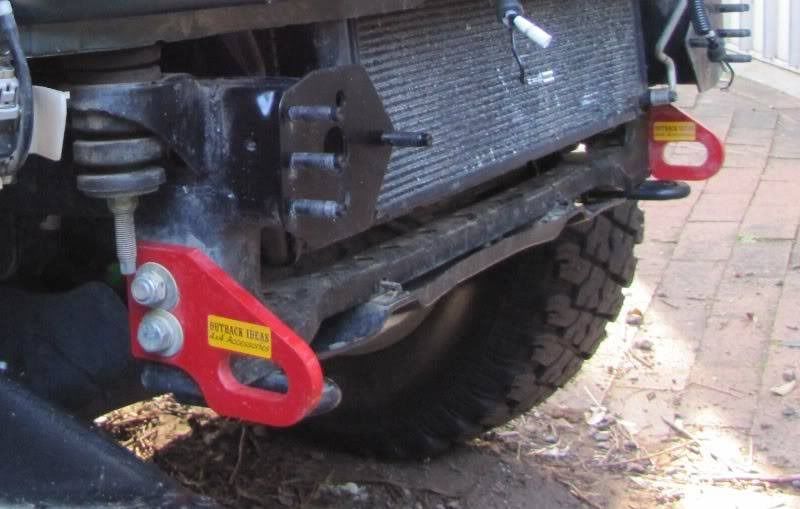
Giles, my belief is that they both use the same location for fitting. They both use the bottom hole where the recovery points are fitted that you show in Boomslang's photo. The ARB Chassis Support Brackets (P/Ns 3756645L,R) use that hole and extend up past and behind that position and are folded on their edge in the position and side that the recovery points need to fit onto.
I suggest you go look under a completed installation of the bar I mentioned and look at Boomslangs photo you refer to and then tell me how to fit these points in the same position. Or better still show us a photo of an installation that has both already fitted. The photo above does not show me a bullbar fitted, only your recovery points. Boomslang may have another bar or no bar for all i know, or if he has an ARB Deluxe Winch Bar, I am guessing he does not have these recovery points fitted at all.
thank you, mickLeave a comment:
-
The hooks have a retaing plate that should stop anything coming off, If I was in a situation of using them to tow someone, or be towed for an extended distance I would probably add a cable tie for insurance. The big advantage of the hooks is that they are always there, no chance of taking the shackle out and using it for something else and forgetting to put it back in the car.Originally posted by wooley View Post
Cheers AndrewLeave a comment:
-
do you ever have issues with hooks? i've found that when using them on trucks, tractors, utes, that sometimes the snatch strap, chain, string being used falls off them?Leave a comment:
-
Given that there are no standards for recovery points I use the following as a guide. It is taken from a 4WD training manual, National Outdoor Recreation Industry training Package (SRO 03), Drive and recover a 4WD vehicle SRO DRV 001B, put out by the SAAFWDC and would apply across Australia.
Based on this information, I use rated hooks (yes rated to 10000lb, marked on the packaging and stamped on the hook) attached either directly to the chassis or on solid mounting points that are securely attached to the chassis. Page 1 of my rig build shows the setup I had, the last page shows the updated method which I will finalise on the weekend subject to getting my brackets from the powder coaters. I also have the same rated hooks bolted directly to the chassis of my Camper trailer. Of course I have the 120 not the 150 but a similar principal should apply.6.1.2 Recovery points.
Recovery points must be attached to the front and rear of the vehicle. At each recovery point, rated recovery hooks must be securely attached to the vehicle chassis or on solid mounting points that are securely attached to the chassis.
If these recovery points are bolted to the chassis, high tensile bolts of the appropriate size must be used to attach them.
WARNING:
Tie down points are not recovery points and must not be used for recovery purposes. Tie down points have only been designed to restrain vehicle movement while being transported.
Tow Bars are not recommended for use as a recovery point. Most tow bars have a design loading rating less than the rating required for recovery purposes.
Tow balls are NOT to be used as a recovery point. Tow balls are not, generally, made of high tensile material; they have been known to fracture and are not directly attached to the chassis.
WARNING: DO NOT USE TOW BALLS AS A RECOVEY POINT
2 hooks front and rear on the Prado, and another 2 hooks on the rear of the CT so a bridle can be used to distribute the weight evenly.
Cheers AndrewLeave a comment:
-
My thoughts are that Toyota provided a set of tie down points to keep the car in one spot on a boat. The load on the boat is pulling at about 45 degrees to the chassis and this is evident in the shape and design of the tie down points. I think these should be removed once the vehicle has been delivered by the dealer and not used for recovery. I put them in the same category as using tow balls for recovery.
Outback ideas have designed a recovery point for the purpose of recovering a vehicle, and I have purchased a set to fit up to my 150 series because from what I have seen they are the most suitable recovery point available in the Aussie market for a 150 series Prado and I would much rather have the OI recovery points than the Toyota tie down points. For me it is about the safety of myself, my passengers and just as importantly the vehicle recovering me.
Similarly at the rear I have a tow hitch receiver style recovery point for rear recoveriesLeave a comment:
-
 Guest repliedIn the absence of Toyota's specification on the strength of its chassis and its tow point, the next best thing an owner can do is get the best available recovery point. If the OI recovery points are the only ones that have actually been tested, albeit not to any standard, then engineering judgement will tell you that it is the best recovery point currently available.
If the recovery point went past the yield point but did not break during the test, then it has done it's job and you need to get new ones. The bolts broke but it is not clear in the report of how the recovery point was mounted. To me, the chassis is the weak point, but we won't know for sure until an actual vehicle was tested. Maybe test a rear ended wreck stuck up to the chassis in mud loaded with gear for outback travel?Leave a comment:
-
I also agree with Andrew's comments. What is the point of rating or testing a recovery point in a test frame anayway. Surely it is its performance in the vehicle that counts. I don't want my car's frame to be the weakest link. Unfortunately, Toyota refuse to give any guidance on the capacity of the tow points provided so unless someone tests one in a real vehicle, I don't see a 'rating' of being much value.Leave a comment:
-
i am still waiting for an answer on how these on a 120 fit in that position when an arb bar is already fitted there using the same fixing pposition. I have received a PM from giles saying they dont use the same fixing position. i would love someone to please explain where/how/why?? sorry not trying to hijack the 150 guys, but they posted up a pic of a 120 with them fittied and said they will fit, so thought it would be great to get some clear accurate answers all on the one thread for all to see about these points. and if they do fit, let me know how and i will go buy themOriginally posted by Giles View PostLeave a comment:
-
I have contacted the testing company, as listed in the header of the document for further information...
Included in my initial email are queries relating to the missing WLL? Is it a certificate? Is it just a test report?
Does having it posted or linked on the public forum open up the forum and/or the individual to potential litigation?
Has the document been provided in full?
Provided link to the document in question.Last edited by Matty80; 06-07-2011, 11:50 PM.Leave a comment:
-
Yeah no, I understand exactly where you're coming from, but this thread seems to be going in circles, and I feel like people should draw their own conclusions as I agree 100% with Andrew, as there is no Australian standard for recovery points a rating is a bit useless and not available.
Testing something to destruction is not a great indication of what kind of a force you can exert on something time and time again.
Do you want me to do something about? Do you want me to harass the outback ideas guy for answers? :P
:P
Leave a comment:
-
Thankyou Andrew.
Wooley,
If it was my job, too find out these details I would be paid for it... unfortunately, i am not! so in the interest of trying to get the right people to tell YOU the truth, why should I do the leg work? As it is my inbox is filling with details along the exact same line as Andrews post - so i ask you what are you doing about it all?Leave a comment:
-
Interestingy the way I read that certificate theat you posted Giles, it tells me that they are NOT rated. They were tested to destruction, at 89.2kn or roughly 20,000lb or approx 9000kg when they failed due to bolts breaking from the recovery point bending. One of the things that is almost never mentioned about "rated" recovery points is that it has to be adequately rated. A point rated to 100lb might be rated, but is useless as the rating is far to low. Anyway the figure I have heard for these and most other recovery points is 10,000lb so lets assume that is the figure. It failed completely at almost twice this force, but it gives no indication of when it started to deform.
Now lets look at something that is rated and highly regulated, shackles. A 4.7 tonne rated shackle needs to achieve an Australian standard breaking strain no less than 28.5 tonne! So comparing a shackle to the recovery point (10,000lb is roughly 4.5tonne) the recovery point falls well shoart of that standard.
All this aside the real clincher for me is the column on the right WLL, working load limit, it says not applicable. My understanding is the rating for slings and shackles and almost anything else, the rating is expressed as the WLL (working load limit) or the SWL (safe working limit). If it doesn't have a WLL then how can it be "rated".
Added to that if the WLL is not marked on each individual recovery point, regardless of any testing then it is not rated, assuming we apply similar rules to all other lifting type equipment.
Now don't get me wrong, I am not saying they aren't adequate or are unsafe, I will leave that to each individual to decide for themselves. The problem is people want "rated" recovery points when as far as I know no Australian standard exists for recovery points. Personally I think we should all drop the term "rated" and talk about adequate, or suitable, or safe recovery points.
It has been quite a while since I did any training around lifting and shackles and the like, so if anything I have written above is blatently wrong feel free to correct me.
Cheers AndrewLeave a comment:
-
with all respect, isn't it your job to contact John at outback ideas if you so urgently want to know this information?Leave a comment:

Leave a comment: